
You have unsold seats across several tours. Which departure should your team promote first?
The one leaving soonest? The one with the most empty seats? Or the one that is already selling well and only needs a final push?
Most travel agencies cannot answer without opening a spreadsheet, checking the booking list, asking sales for an update, and counting seats again. By the time everyone agrees, another day has passed.
Unsold seats are normal. Not knowing which ones are becoming a problem is expensive.

Twelve empty seats can mean two very different things
Imagine two departures, each with 12 seats left.
| Departure | Seats sold | Time remaining | What it means |
|---|---|---|---|
| Japan autumn tour | 18 of 30 | Several months | There is still time to build demand |
| Seoul group tour | 18 of 30 | Next week | The sales window is almost closed |
The number of empty seats is the same. The risk is not.
This is why a seat count alone does not tell an agency owner what to do. You need to see capacity, confirmed bookings, and the departure date together.
Why agencies notice slow departures too late
The information is usually split across the business:
- The product and departure dates are in a spreadsheet
- New bookings are recorded somewhere else
- Interested customers are still inside WhatsApp chats
- Seat availability is updated manually
- Sales progress is known by one or two senior staff
Nobody is deliberately hiding the numbers. The team is busy, and there is no single view that turns those numbers into a clear priority.
So marketing promotes whichever package already has artwork. Sales follows up with the customer who messaged most recently. The owner only notices the weak departure when a supplier payment is due or the travel date is uncomfortably close.
The question is not “What should we sell?”
Your team already knows what products you offer. The more useful question is:
Which departure needs help today?
To answer it properly, you need to know:
- Which departures are already filling quickly?
- Which ones have low bookings but enough time to recover?
- Which ones are close to departure with too many seats left?
- Which departures are missing a capacity figure?
- Where should sales calls and marketing budget go first?
That is what Departure Health in WauHub is designed to show.
Hot, Slow, or Needs attention
Departure Health sorts upcoming departures into three straightforward groups.
| Status | What you are seeing | What your team can do next |
|---|---|---|
| Hot | Seats are filling well | Follow up warm prospects and use genuine limited availability to close sales |
| Slow | Bookings are low, but there is still time | Contact past enquiries, review the offer, and run a focused campaign |
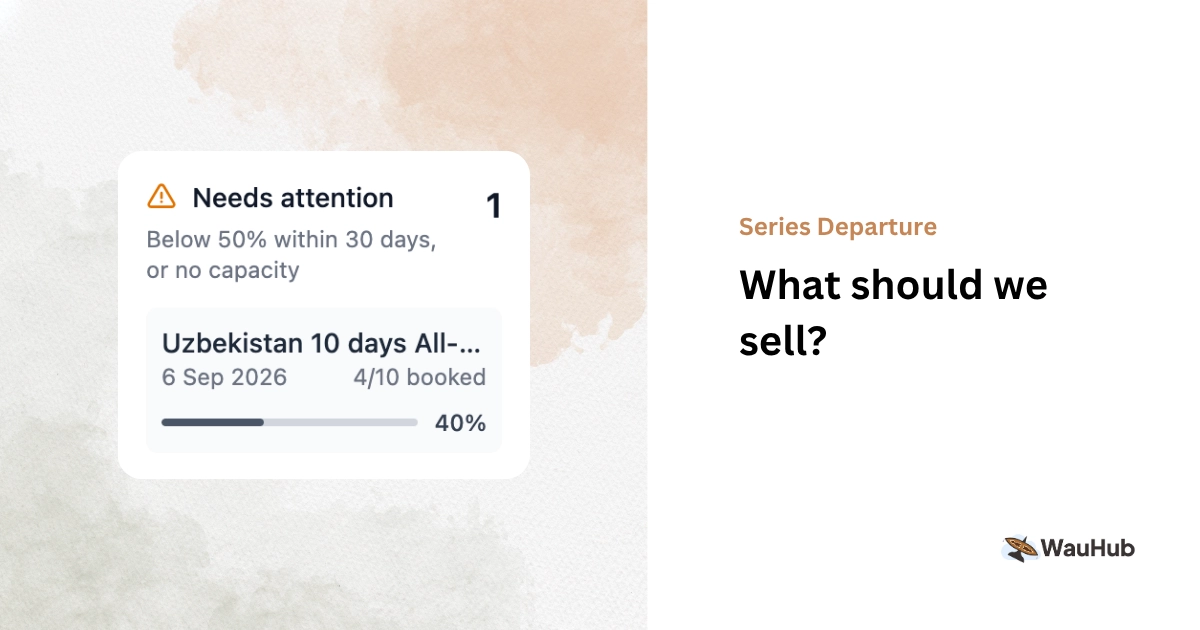
| Needs attention | Too many seats remain as departure gets closer, or capacity is missing | Check the data, assign an owner, and decide on an immediate response |
You do not have to inspect every departure or build another report. Open the view, start with Needs attention, and give the team a clear list for the day.
Give sales something more useful than “sell more”
“Please push sales” is not a sales plan.
A useful instruction sounds like this:
Focus on the Seoul departure today. We still have 12 seats, and six customers have already asked about Korea.
Now the consultant knows which enquiries to reopen. The sales manager can check whether the offer needs better positioning. Marketing knows which departure deserves a post or campaign.
Everyone works on the same priority instead of choosing a different package based on instinct.
Promote the right tour, not every tour
A small agency cannot advertise every departure equally. Even a bigger agency should not.
Departure Health helps you decide where promotion can still make a difference:
| What you see | A sensible response |
|---|---|
| Slow departure with plenty of time | Test a specific audience, message, or sales follow-up |
| Hot departure with a few seats left | Focus on warm prospects instead of paying for broad reach |
| Weak departure close to travel | Check margin and supplier commitments before spending more |
| Missing seat capacity | Correct the record before making a marketing decision |
This does not remove the need for judgement. It gives that judgement current information.
A hot departure deserves attention too
Hot does not mean “ignore this tour”. It means demand is working.
Your team may be able to close the final seats by following up quickly and making the remaining availability clear. You can also look for the reason behind the demand. It may be the destination, departure date, school holiday timing, flight arrangement, price, or the consultant handling the enquiries.
Once you know what worked, you can use that lesson when planning another departure. Do not simply assume every similar tour will perform the same way.
Slow is useful when you see it early
A slow departure is not automatically a failed departure. If there is enough time left, it is an opportunity to act.
Your team can:
- Revisit customers who enquired but did not book
- Check whether the package message is clear
- Brief consultants on the strongest selling points
- Target a more relevant customer group
- Review the price and offer without rushing into a discount
Those options shrink as departure approaches. Early visibility gives you choices. Late visibility gives you pressure.
“Needs attention” can also mean your data is incomplete
Sometimes the problem is not sales. Nobody entered the capacity.
If a departure has no seat limit, the agency cannot tell whether 18 bookings are excellent, average, or risky. WauHub flags the missing information so the team can correct it instead of making decisions from an unreliable number.
That small check matters. A dashboard is only useful when the booking and capacity records behind it are kept current.
Make Departure Health part of the morning routine
This does not need another long management meeting.
Use a short review:
- Open Needs attention and confirm the seat numbers are correct
- Assign each risky departure to a named person
- Check Slow departures and choose the ones worth promoting
- Review Hot departures for warm leads that can still convert
- Agree on today’s calls, messages, and campaigns
Your team leaves the discussion knowing exactly where to start.
You do not need another spreadsheet
As the agency grows, remembering every seat and departure becomes impossible. More spreadsheet tabs only create more places for the numbers to disagree.
WauHub connects departures, capacity, and bookings so you can see which tours are filling up and which ones need action before the sales window closes.
No guessing. No waiting for one staff member to count the seats. Just a clearer answer to the question that matters today: which departure should we sell next?
Related reading
- The 30-Day Group Departure Checklist for Malaysian Travel Agencies
- Explore WauHub booking and passenger management
- See how WauHub supports fixed departures and capacity
Have unsold tour seats but no clear priority?
See how WauHub can show your team which departure to focus on first →