
A family of six wants a 12-day Europe trip. Budget: RM52,000. Dad wants golf in Scotland. Mum wants shopping in Paris. The teenagers want theme parks. Nenek needs wheelchair access, halal food, and a ground-floor room because she cannot do stairs.
Now tell me which AI chatbot is closing that booking.
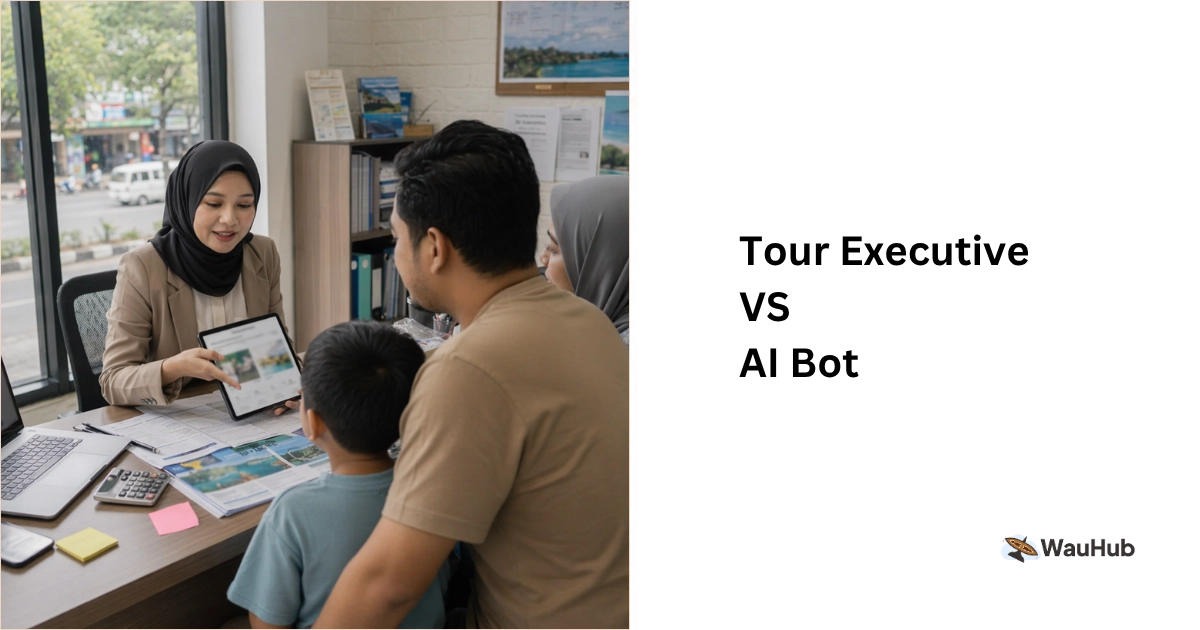
The RM50,000 Conversation
Every tech publication is running the same headline: AI will replace travel agents. The articles quote chatbots that can “plan a trip in seconds” and AI tools that generate itineraries from a single prompt.
What they never mention is the sale itself.
A RM50,000 FIT booking is not a transaction. It is a negotiation that unfolds over days, sometimes weeks. It involves:
- 14 WhatsApp messages before the customer even confirms dates
- 3 phone calls to discuss hotel options and flight routings
- 1 voice note at 10pm asking “can we add one night in Lucerne?”
- A revised quotation after the customer’s mother-in-law decides to join
- Another revision when the budget shifts by RM4,000
No chatbot handles that. Not because the technology is not advanced enough. Because the customer does not trust a chatbot with RM50,000.
Trust Is the Product
When someone spends RM50,000 on a family holiday, they are not buying an itinerary. They are buying confidence that nothing will go wrong.
They need to hear a human voice say “I have sent clients to this hotel before, the halal options are good.” They need someone who remembers that Nenek cannot walk far and quietly rearranges the Venice day to avoid cobblestones. They need a person who picks up the phone when the flight gets cancelled at 2am.
AI can generate a beautiful itinerary in 30 seconds. But it cannot say “trust me, I have done this route six times.” That sentence closes deals. That sentence is worth RM50,000.
| What AI Can Do | What AI Cannot Do |
|---|---|
| Generate a draft itinerary | Read between the lines of what the customer actually wants |
| List hotels in a city | Know which hotel has real halal food vs “halal-friendly” marketing |
| Calculate route distances | Sense that the customer is hesitant and needs reassurance |
| Translate languages | Build a relationship that leads to repeat bookings |
| Summarise reviews | Take responsibility when something goes wrong |
| Respond instantly | Earn trust for a RM50,000 decision |
FIT Is a Ping Pong Game
Group tours are straightforward. Fixed dates, fixed price, fixed itinerary. A customer either books or does not.
FIT custom tours are the opposite. Every booking is a conversation.
The customer says “we want Japan in autumn.” You ask how many days. They say “maybe 10, maybe 12, depends on budget.” You send a draft. They come back with “can we skip Osaka and add two nights in Hakone?” You revise. They ask about bullet train passes. You explain the options. They go quiet for three days. You follow up gently. They come back with “my wife wants to add Disneyland for the kids.”
This is not a transaction that AI can automate. This is a human relationship where the agent reads mood, manages expectations, offers alternatives, and adjusts in real time.
The best agents close these bookings because they listen to what is NOT said. When a customer asks about budget three times, they are worried about money but embarrassed to say it. When they keep mentioning halal food, they are anxious about travelling with elderly parents. When they take five days to reply, they are discussing it with family.
No AI reads those signals.
The Numbers Do Not Lie
Here is what a typical FIT custom tour sale looks like in Malaysia:
| Stage | Touchpoints | Time |
|---|---|---|
| Initial enquiry to first quotation | 3-5 WhatsApp messages, 1 call | 1-2 days |
| First quotation to revision | 2-4 messages, questions, changes | 3-5 days |
| Revision to second revision | New requests, budget discussion | 2-4 days |
| Final quotation to deposit | Reassurance, payment options | 1-3 days |
| Deposit to full payment | Document collection, add-ons | 1-4 weeks |
Total: 10 to 40 touchpoints across 2 to 6 weeks.
Each touchpoint requires judgment. Each requires context from the previous conversation. Each requires a human who remembers that this customer’s son has a nut allergy and their flight preference is always morning departures.
An AI that loses context after one session is useless here. An AI that remembers everything but sounds robotic is worse, because it creates an uncanny valley of fake personalisation that Malaysian customers see through instantly.
“But What About Simple Bookings?”
Fair point. Not every booking is RM50,000.
Here is the truth: AI chatbots work fine when the AOV is below RM200 and the product is fixed. Shoes, pants, shirts. Pick a size, pick a colour, pay. There is no conversation needed because there is nothing to customise. The product is the product.
Travel is the opposite. Even a “simple” RM2,800 Bandung group tour has questions. Can I request a window seat? Is the hotel near a halal restaurant? What happens if my kid gets sick and we need to cancel? These are not size-chart questions. They need judgment.
A RM2,800 Bandung group tour with fixed dates? Sure, the booking part could be automated. The customer picks a date, pays online, done. But the moment they have a question that is not in the FAQ, the chatbot falls apart.
But here is the reality for most Malaysian agencies: the simple bookings are not where the money is.
| Booking Type | Average Value | Margin | Conversation Needed |
|---|---|---|---|
| Group tour (fixed departure) | RM1,500-3,500 | 8-12% | Low |
| Semi-custom (FIT lite) | RM5,000-15,000 | 12-18% | Medium |
| Full FIT custom | RM15,000-80,000 | 15-25% | High |
| Corporate/incentive | RM50,000-300,000 | 18-30% | Very high |
The high-margin work is the human work. Automating the low-margin stuff saves time, but it does not replace the agent. It frees the agent to handle more RM50,000 conversations.
What AI Actually Gets Wrong
The AI travel tools that exist today have specific failure modes that matter for Malaysian agencies:
Halal is not a checkbox. AI tools treat halal as a filter. Real agents know that “halal-certified restaurant” in Tokyo is different from “Muslim-friendly” which is different from “self-catering apartment near a halal grocery.” A family with strict dietary needs requires a human who understands the spectrum.
Visa complexity. Malaysian passport holders have different visa requirements than the AI’s training data assumes. An AI suggesting “visa-free travel to Japan” is correct, but it does not know that your customer’s Indonesian spouse needs a different process entirely.
Local supplier relationships. Your ground handler in Turkey gives you a better rate because you send 20 groups a year. AI does not negotiate. AI does not have a WhatsApp group with a bus operator in Cappadocia who answers at midnight.
Seasonal knowledge. AI knows that cherry blossom season is March-April. Your agent knows that the third week of March 2027 has a Japanese public holiday that triples hotel prices in Kyoto, and suggests shifting to week two instead.
The Real Threat Is Not AI
The real threat to travel agents is not artificial intelligence. It is inefficiency.
The agent who loses a RM50,000 booking did not lose it to a chatbot. They lost it because:
- They took 48 hours to reply to the first enquiry
- They could not find the customer’s previous quotation
- They sent the wrong pricing because they were working from an outdated spreadsheet
- They forgot to follow up after the customer went quiet
- They manually typed the same passport details three times and made an error
These are not AI problems. These are operations problems. The customer left because the agent was slow, disorganised, or unreliable, not because a robot offered a better itinerary.
Where Software (Not AI) Actually Helps
The solution is not replacing the agent with AI. The solution is giving the agent better tools so they can handle more high-value conversations without dropping balls.
| Problem | What Fixes It |
|---|---|
| Slow first reply | Lead notifications and routing |
| Lost quotation history | Centralised customer records |
| Pricing errors | Quotation system with live costing |
| Forgotten follow-ups | Task reminders and pipeline tracking |
| Payment delays | Online payment links with auto-reminders |
| Admin overload | One-click booking creation from accepted quotations |
None of this is AI. It is workflow. It is making sure the RM50,000 conversation does not die because of a RM50 admin mistake.
The best Malaysian travel agents do not need a robot to plan trips. They need a system that handles the boring stuff (invoices, payment chasing, document collection, data entry) so they can spend their time on the work that actually makes money: the conversation.
The Future Is Human + System, Not Human vs AI
Five years from now, the travel agents still thriving in Malaysia will not be the ones who adopted AI chatbots. They will be the ones who:
- Respond fastest to high-value enquiries
- Remember everything about their repeat customers
- Send quotations within hours, not days
- Follow up systematically without forgetting
- Collect payments without chasing
- Track margins per booking so they know which tours are worth their time
That is not AI. That is organised, efficient operations backed by proper travel agency software.
The RM50,000 booking will always go to the agent who picks up the phone, remembers the customer’s name, and says “I know exactly what your family needs.” No chatbot will ever compete with that.
Your customers do not want a chatbot. They want you, minus the slow replies and lost quotations. See how WauHub handles the operations so you can focus on the conversation →