
Agency A and Agency B both sell a 6D5N Japan Cherry Blossom tour. Same destination. Same hotels. Same flight. Same selling price: RM5,500 per person. Group of 20 pax. Total revenue: RM110,000.
Both pay the same supplier costs: RM82,000 for flights, hotels, meals, transport, and guide fees. Both face the same fuel surcharges from bus operators and airlines. Both deal with the same rising costs in 2026.
Gross profit for both: RM28,000.
But at the end of the month, Agency A takes home RM5,000 net profit from this tour. Agency B takes home RM500.
Same tour. Same price. Same suppliers. RM4,500 difference in profit.
Where did the money go?
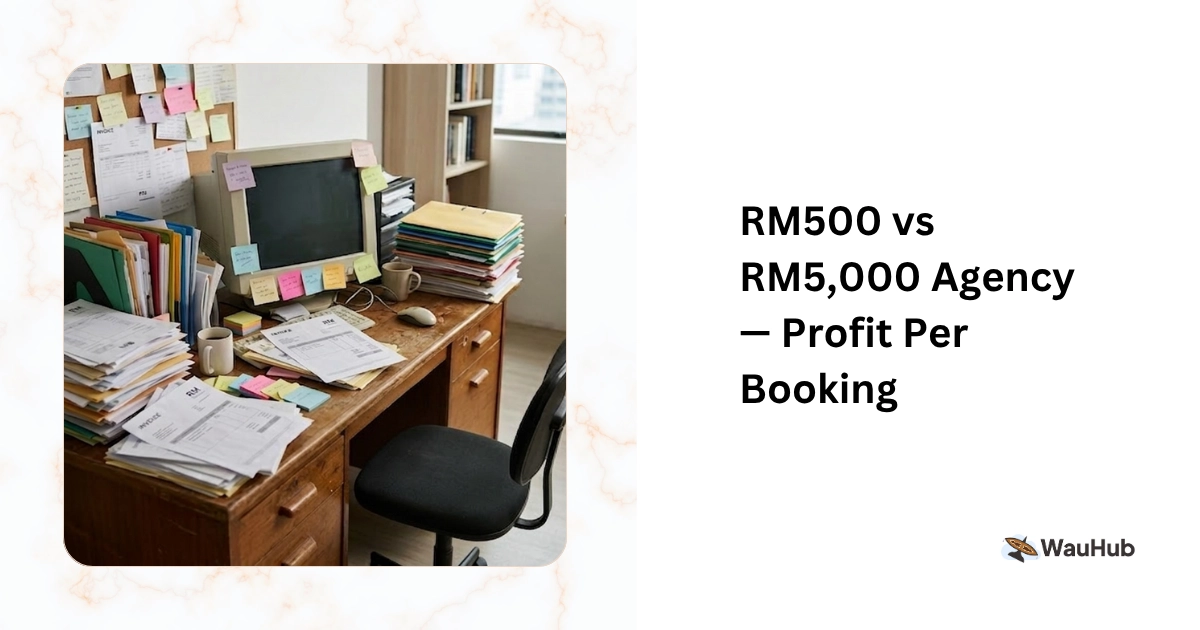
This is Part 4 of our Cost-Cutting and Efficiency Series. Part 1 covered cutting costs during the fuel crisis. Part 2 covered remote work to save on minyak. Part 3 covered flexible hours. Now we show you why operational efficiency is the real profit driver — especially when rising fuel prices squeeze your margins from every direction.
Why Efficiency Matters More in 2026
When diesel was RM2.15, a RM500 fuel surcharge on a group tour was annoying but manageable. With diesel at RM6.02, that surcharge is RM1,400. Your supplier costs go up. Your office electricity goes up. Your staff ask for transport allowances.
If your margins were already thin because of inefficient operations, the fuel crisis does not just squeeze you. It crushes you.
The agencies that survive rising costs are not the ones that raise prices the fastest. They are the ones whose operations cost the least to run. When your overhead is low, you can absorb cost increases that kill your competitors.
The Hidden Costs That Eat Your Profit
Gross profit is not net profit. Between the two sits a mountain of operational costs that most agencies never properly calculate.
Let us break down what happens to that RM28,000 gross profit at Agency B (the inefficient one):
| Operational Cost | Amount | Why |
|---|---|---|
| Staff time on admin (invoicing, chasing payments, data entry) | RM4,200 | Multiple staff spending hours on manual work |
| Payment collection delays (2 customers paid late, needed extra follow-up) | RM800 | Staff time chasing payments |
| Quotation revisions (multiple rounds of changes, manual each time) | RM1,500 | Hours of consultant time on back-and-forth |
| Errors and corrections (wrong room type booked, invoice amount wrong) | RM2,000 | Supplier penalty + staff time to fix |
| Printing and courier (physical documents, receipts) | RM300 | Paper, ink, postage |
| E-Invoice manual submission (20 invoices × 15 min each) | RM500 | 5 hours of accounts staff time |
| Monthly software overlap (3 separate tools) | RM700 | CRM + accounting + invoicing |
| Office overhead allocated to this tour | RM13,500 | Full office rent, utilities (up with fuel costs), equipment |
| Staff commute costs (agency-borne transport allowance) | RM1,000 | 4 staff × RM250/month partial allowance |
| Total operational cost | RM24,500 |
Net profit: RM28,000 - RM24,500 = RM3,500
And that is before taxes, insurance, and the cost of leads that did not convert. When you spread total monthly overhead across actual bookings, the number drops to around RM500 per tour.
Now let us look at Agency A (the efficient one):
| Operational Cost | Amount | Why |
|---|---|---|
| Staff time on admin | RM800 | 1 staff × 4 hours (automated invoicing, payment links) |
| Payment collection | RM0 | Payment links sent via WhatsApp, paid within hours |
| Quotation process | RM300 | Template-based, 1 revision, 3 hours total |
| Errors and corrections | RM200 | System validates data, fewer mistakes |
| Printing | RM0 | Everything digital |
| E-Invoice submission | RM0 | Automatic via system |
| Software cost | RM250 | One integrated system (proportional) |
| Office overhead allocated | RM3,000 | Small office, hybrid team, lower electricity |
| Staff commute costs | RM0 | Team works from home, no transport allowance needed |
| Total operational cost | RM4,550 |
Net profit: RM28,000 - RM4,550 = RM23,450
Agency A makes RM23,450 from the same tour that Agency B makes RM500 from. Not because they charge more. Not because they found cheaper suppliers. Because their operations cost less to run. And because they do not burn money on a full office and daily commutes that the fuel crisis has made painfully expensive.
The 7 Efficiency Gaps Between RM500 and RM5,000 Agencies
Gap 1: Time Per Invoice
Inefficient agency: 15 to 20 minutes per invoice. Open Word template. Type customer details. Calculate amounts. Format. Save as PDF. Send via email or WhatsApp. Then separately submit to LHDN for e-Invoice.
Efficient agency: 2 minutes. Click “Generate Invoice” from the booking. System pulls all details automatically. Send payment link via WhatsApp. E-Invoice submits to LHDN automatically.
For 20 invoices per tour, that is 6 hours saved. At RM50 per hour staff cost, that is RM300 saved per tour.
Gap 2: Payment Collection Speed
Inefficient agency: Send bank account details. Wait. Remind after 2 days. Wait. Remind again. Customer finally transfers on day 5. You check bank statement. Match the transfer to the booking. Confirm receipt.
Average collection time: 5 days. Staff time per collection: 30 minutes.
Efficient agency: Send payment link. Customer pays via FPX in 10 minutes. System auto-confirms. Receipt auto-generates.
Average collection time: 4 hours. Staff time per collection: 0 minutes.
For 20 customers, the inefficient agency spends 10 hours on payment collection. The efficient agency spends zero.
Gap 3: Quotation Turnaround
Inefficient agency: Customer asks for a quote. Consultant opens a blank document. Types the itinerary. Calculates pricing manually. Formats it nicely. Sends PDF. Customer asks for changes. Consultant edits the document. Sends again. Three rounds of revision.
Time per quotation: 2 to 3 hours including revisions.
Efficient agency: Consultant selects the package template. Adjusts dates and room types. System calculates pricing. Sends a link where the customer can view the full itinerary with photos, pricing, and a booking button. Customer requests changes. Consultant adjusts in 5 minutes. Link updates automatically.
Time per quotation: 20 to 30 minutes including revisions.
Gap 4: Error Rate
Manual data entry creates errors. Wrong dates. Wrong room types. Wrong pricing. Wrong customer name on the invoice.
Each error costs time to fix and sometimes costs money (supplier penalties, customer compensation, reprinting).
Inefficient agency: Errors happen regularly with manual data entry. Average cost per error: RM200 (time + penalties).
Efficient agency: System validates data at entry. Booking details flow to invoices, vouchers, and e-Invoices automatically. Errors drop significantly. Most are caught before they cause damage.
Gap 5: Office and Commute Overhead
This gap has widened dramatically in 2026.
Inefficient agency: Full office with 5 desks, meeting room, filing cabinets. RM5,000 rent. RM1,000 utilities (up from RM800 because electricity follows fuel costs). Everyone commutes every day. Staff transport allowance: RM1,000/month. Total: RM7,000/month.
Efficient agency: Small office or co-working space. RM1,500 rent. RM300 utilities. Team works hybrid from home. No transport allowance needed because commuting is optional. Total: RM1,800/month.
Annual difference: significant. And that gap has only widened since fuel prices spiked. The fuel crisis has made office-based operations even more expensive relative to remote ones.
Gap 6: Staff Utilisation

Inefficient agency: 5 staff handling 80 bookings per month. That is 16 bookings per person. Each person spends most of their time on admin.
Efficient agency: 3 staff handling 80 bookings per month. That is 27 bookings per person. Each person spends a fraction of their time on admin and the rest on selling and customer service.
Same output. Two fewer salaries. RM7,000 per month saved. And two fewer people commuting, which matters when you are trying to keep costs down.
Gap 7: Software Costs
Inefficient agency: Separate CRM (RM200/month), accounting software (RM150/month), invoicing tool (RM100/month), website builder (RM80/month), email marketing (RM50/month). Total: RM580/month.
Efficient agency: One integrated system that handles bookings, invoicing, payments, leads, e-Invoice, and customer management. RM300 to RM500/month.
Small saving individually. But combined with everything else, it adds up.
The Compound Effect
Each efficiency gap seems small on its own. RM300 here. RM500 there. But they compound:
| Efficiency Gain | Monthly Saving |
|---|---|
| Automated invoicing | RM600 |
| Payment link collection | RM1,000 |
| Faster quotations | RM800 |
| Fewer errors | RM400 |
| Reduced office + commute overhead | RM5,200 |
| Better staff utilisation | RM7,000 |
| Consolidated software | RM200 |
| Total monthly saving | RM15,200 |
RM15,200 per month. RM182,400 per year. That is the difference between an agency that struggles to break even and one that is consistently profitable — even when diesel is RM6.02 and customers are tightening their belts.
And this does not count the revenue increase from faster response times, better lead management, and 24/7 payment collection. That typically adds a meaningful bump in bookings for most agencies.
How to Calculate Your Agency’s Efficiency Score
Here is a simple exercise. Calculate your cost per booking:
Total monthly operating cost ÷ Total monthly bookings = Cost per booking
| Efficiency Level | Cost Per Booking |
|---|---|
| Highly inefficient | RM800+ |
| Average | RM400 - RM800 |
| Efficient | RM200 - RM400 |
| Highly efficient | Under RM200 |
If your cost per booking is above RM500, you have significant room for improvement. Every RM100 you reduce from your cost per booking goes straight to your bottom line.
For an agency doing 80 bookings per month, reducing cost per booking by RM200 means RM16,000 more profit per month. RM192,000 per year.
The Efficiency Roadmap
Month 1: Automate Invoicing and Payments
This is the quickest win. Stop creating invoices manually. Stop chasing payments via WhatsApp. Payment links and automated invoicing save 1 to 2 hours per day immediately.
Month 2: Streamline Quotations
Build templates for your top 10 packages. Use a system that lets you customise quickly and share via link. Cut quotation time from hours to minutes.
Month 3: Centralise Lead Management
Every lead in one place. Auto-assigned. Tracked. Followed up. No more leads lost in WhatsApp chats. This increases conversion rate, which means more revenue from the same marketing spend.
Month 4: Go Hybrid
Start remote work. Follow PM Anwar’s advice. Measure productivity. If results hold (they will), increase remote days. Reduce office space when your lease renews. Your staff save on petrol. You save on rent and utilities.
Month 5: Implement Flexible Shifts
Cover evening hours with a remote shift. Capture the leads that come after 6 PM — and there are a lot of them. This is pure revenue growth with minimal cost increase. Evening shift works from home — zero fuel cost.
Month 6: Review and Optimise
Calculate your new cost per booking. Compare to Month 1. The improvement should be dramatic. Identify remaining inefficiencies and address them.
The Bottom Line
Travel is a competitive industry. Margins are thin. And in 2026, with fuel prices squeezing costs from every angle, margins are thinner than ever.
The agencies that thrive are not the ones with the best destinations or the lowest prices. They are the ones with the lowest cost to operate.
When your cost per booking is RM200 and your competitor’s is RM600, you can:
- Absorb fuel surcharges without raising prices as much
- Price more competitively and still profit
- Invest more in marketing and grow faster
- Survive the slow months when customers cut travel budgets because minyak naik
- Pay your staff better and retain talent
- Build cash reserves for the next crisis
Efficiency is not about working harder. It is about removing the waste that sits between your revenue and your profit.
Read the Full Series
- Part 1: Diesel RM6.02, Minyak Naik: How Travel Agencies Can Cut Costs
- Part 2: How Travel Agency Teams Can Work From Home (Save on Petrol)
- Part 3: Running a Travel Agency on Odd Hours: Night Shifts, Weekend Teams, and Flexible Schedules
- Part 4: The RM500 vs RM5,000 Agency: Why Efficient Agencies Earn More Profit Per Booking (you are here)
Ready to become an RM5,000 agency?
WauHub helps Malaysian travel agencies cut operational costs, automate admin work, and increase profit per booking. One system for bookings, invoicing, payments, leads, and e-Invoice. Works on phone, iPad, and laptop. Your team works from home. Your margins stay healthy.
We will calculate your current cost per booking and show you exactly where the savings are.