
Diesel just hit RM6.02 per litre. Unsubsidised RON95 is at RM3.87. Even with BUDI95, the monthly quota has been cut from 300 litres to 200 litres starting April 2026.
The US-Iran conflict has disrupted global oil supply. Crude prices have topped US$100. And for Malaysian travel agencies, the impact goes far beyond what you pay at the pump.
Your staff commute to the office every day. Your suppliers charge fuel surcharges on transport. Airport transfers cost more. Tour bus operators raise prices. Even your office electricity bill climbs because TNB generation costs follow fuel prices.
PM Anwar has urged private companies to implement work-from-home arrangements to cope with rising fuel costs. MEF (Malaysian Employers Federation) recommends WFH for non-critical roles, carpooling, and public transport.
For travel agencies, this is not just advice. It is a survival strategy.
This is Part 1 of our Cost-Cutting and Efficiency Series for Malaysian travel agencies navigating the fuel crisis.
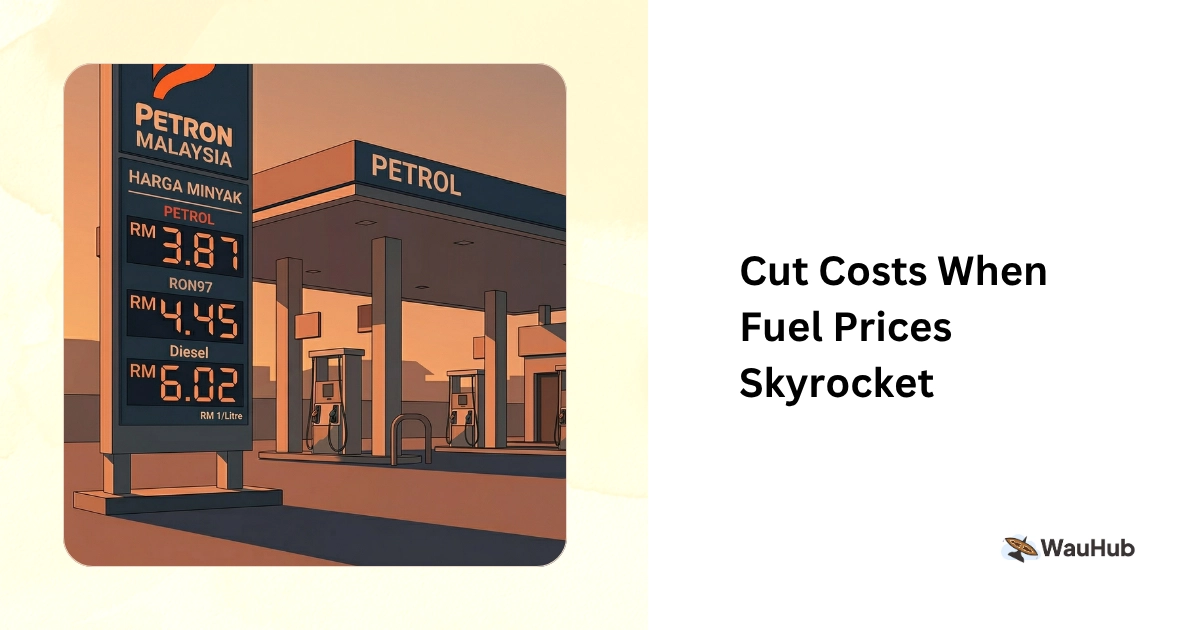
The Fuel Cost Impact on Travel Agencies
Most agency owners think fuel prices only affect tour pricing. But the hidden costs are bigger:
| Cost Area | How Fuel Prices Hit You |
|---|---|
| Staff commute | Staff spending RM400-800/month on petrol ask for transport allowance or salary increase |
| Office utilities | Electricity tariffs rise with fuel costs. Your RM800/month bill becomes RM1,000+ |
| Supplier pricing | Bus operators, van rentals, airport transfers all add fuel surcharges |
| Tour costing | Ground transport costs going up. Your quoted prices may no longer cover actual costs |
| Customer behaviour | Customers cut discretionary spending. Travel is first to go when minyak naik |
The agencies that survive high fuel prices are not the ones that raise tour prices the most. They are the ones that cut operating costs the fastest.
The 5 Biggest Cost Leaks (And How to Plug Them)
1. Your Team Commutes to an Office They Do Not Need
This is the biggest opportunity right now. PM Anwar is telling the whole country to WFH. Your travel consultants can do 90 percent of their work from a phone or laptop at home.
Think about it. What does your consultant actually do in the office?
- Reply to WhatsApp leads (can do from home)
- Create quotations (can do from home)
- Send invoices and payment links (can do from home)
- Follow up with customers (can do from home)
- Coordinate with suppliers (can do from home)
The only things that genuinely need an office: meeting walk-in customers (how many do you get per week? probably fewer than 3) and team meetings (once a week is enough).
Cost of commuting for a 4-person team:
| Staff Member | Distance | Monthly Petrol (RON95) | With BUDI95 | Without BUDI95 |
|---|---|---|---|---|
| Sarah (Klang to KL) | 35km each way | 140 litres | RM279 | RM542 |
| Ahmad (Kajang to KL) | 28km each way | 112 litres | RM223 | RM434 |
| Nadia (Shah Alam to KL) | 25km each way | 100 litres | RM199 | RM387 |
| Hafiz (Rawang to KL) | 40km each way | 160 litres | RM318 | RM619 |
Total team commute cost: RM1,019 to RM1,982 per month. Just on petrol. Not counting tolls, parking, car maintenance, and the 2 to 3 hours per day each person wastes sitting in traffic.
Go hybrid or fully remote. Save your team money. Save your agency money. Follow the PM’s advice.
We cover remote work in detail in Part 2 of this series.
2. Manual Admin Work = Hidden Salary Cost
Your staff spends hours on tasks that software does in seconds:
- Typing invoices manually: 15-20 minutes each
- Chasing payments via WhatsApp: 30 minutes per day
- Copying customer details between spreadsheets: 20 minutes per day
- Creating quotations from scratch: 25 minutes each
- Submitting e-Invoices to LHDN manually: 10 minutes each
Two to three hours per day per staff member on pure admin. That is a huge chunk of their working hours spent on tasks that do not generate revenue.
If you pay a staff member RM3,500 per month and they spend half their time on admin, that is RM1,750 per month on work that software can automate. Multiply by three staff members: RM5,250 per month in hidden admin costs.
A travel management system that automates invoicing, payment collection, and e-Invoice submission costs RM300 to RM800 per month. The math is obvious.
3. Too Many Staff for the Volume
When fuel prices rise, customers travel less. Your booking volume drops. But your payroll stays the same.
The smarter approach: make each person handle more bookings through better tools, so you need fewer people to begin with.
| Scenario | Bookings Per Staff Per Month |
|---|---|
| Manual processes (Excel, WhatsApp only) | Around 15-25 |
| With proper travel software | Around 40-60 |
| With software + templates + automation | Potentially 60+ |
An agency handling 100 bookings per month needs 5 staff with manual processes. With proper software, 2 to 3 staff handle the same volume. That is RM7,000 to RM10,500 in monthly salary savings.
You are not replacing people. You are making each person twice as productive. During slow periods when customers cut travel budgets because minyak naik, this means you operate with a smaller team without dropping service quality.
4. Office Space You Do Not Fully Need
If your team works from home 3 to 4 days a week, you do not need a large office. Downsize.
| Office Setup | Monthly Cost |
|---|---|
| Full office (5 desks, meeting room) | RM5,000 - RM8,000 |
| Small office (2 desks, hot-desking) | RM1,500 - RM3,000 |
| Co-working space (meeting room only) | RM500 - RM1,000 |
Annual savings from downsizing: RM36,000 to RM84,000. That covers a lot of fuel surcharges.
Plus, smaller office means lower electricity bill. When TNB rates climb with fuel costs, every square foot you do not cool and light saves money.
5. Duplicate Software and Tools
Many agencies pay for multiple tools that overlap:
- Accounting software + separate invoicing tool
- CRM + separate WhatsApp management
- Website builder + separate booking form
- Email marketing + separate customer database
Each subscription costs RM50 to RM300 per month. Four or five overlapping tools: RM500 to RM1,500 per month.
One integrated system that handles bookings, invoicing, payments, leads, and e-Invoice replaces most of these. Consolidate and save.
The Lean Agency Model for 2026

Here is what a cost-optimised travel agency looks like during the fuel crisis:
| Area | Traditional | Lean |
|---|---|---|
| Team size (100 bookings/month) | 5 staff in office | 2-3 staff, mostly remote |
| Office | Full office, RM5,000/month | Small space, RM2,000/month |
| Staff commute cost | RM2,000+/month (team total) | RM400/month (1-2 days in office) |
| Admin time per booking | 45 minutes | 10 minutes |
| Software cost | RM1,500 (multiple tools) | RM500 (one system) |
| Monthly fixed cost | RM30,000+ | RM15,000 |
The lean agency spends half as much. When customers cut travel budgets and your booking volume drops because of the economic squeeze, that lower burn rate is the difference between surviving and closing.
What to Automate First
Start with the tasks that save the most time and money:
Priority 1: Invoicing and Payments
Manual invoicing is the single biggest time waste. Automate invoice creation, payment link generation, and e-Invoice submission. This alone saves 1 to 2 hours per day.
Payment links also mean customers pay faster. No more “I will transfer tonight” that turns into 5 days of chasing. They click, pay via FPX or DuitNow QR, done. Your cash flow improves immediately.
Priority 2: Lead and Customer Management
When business slows down, every lead matters more. Stop losing leads in WhatsApp chats. A centralised system where every enquiry is tracked, assigned, and followed up saves bookings that would otherwise slip away.
Priority 3: Quotations
Pre-built templates with your common packages. Customise per customer in minutes instead of building from scratch. When fuel surcharges change your tour pricing, update the template once and every new quotation reflects the correct price.
Priority 4: Reporting
If you spend hours creating monthly reports in Excel, automate it. Revenue, bookings, outstanding payments, team performance. One click instead of one day. When margins are tight, you need to see your numbers in real-time, not 2 weeks after month-end.
Protecting Your Margins When Supplier Costs Rise
Fuel surcharges from suppliers are unavoidable. But you can manage them:
Track per-tour profitability. When your bus operator adds a RM500 fuel surcharge to a group tour, you need to see immediately how that affects your margin. Not at month-end. Now.
Update pricing quickly. If your Japan tour margin shrinks because of transport cost increases, you need to adjust pricing for new bookings immediately. A system that shows real-time margins per tour lets you react fast.
Communicate transparently. Customers understand that minyak naik affects everyone. A clear breakdown showing “transport cost increased due to diesel price” is better than a mysterious price increase with no explanation.
The Fuel Crisis Survival Checklist
Start this week:
- Calculate your total monthly commute cost (all staff, petrol + tolls + parking)
- Identify which roles can work from home (hint: most of them)
- List every monthly expense and mark what can be reduced
- Calculate your cost per booking (total monthly cost ÷ number of bookings)
- Compare: what would your cost per booking be with automation and remote work?
If the gap is significant, the investment in proper software pays for itself within the first month.
Coming Up in This Series
- Part 2: How Travel Agency Teams Can Work From Home (Phone, iPad, Laptop)
- Part 3: Running a Travel Agency on Odd Hours: Night Shifts, Weekend Teams, and Flexible Schedules
- Part 4: The RM500 vs RM5,000 Agency: Why Efficient Agencies Earn More Profit Per Booking
Ready to cut costs without cutting quality?
WauHub helps Malaysian travel agencies automate admin, enable remote work, and operate leaner. Invoicing, payments, leads, e-Invoice — all in one system that works from phone, iPad, and laptop. Your team works from home. Your customers pay online. Your costs drop.
We will show you exactly how much time and money you can save based on your current booking volume.