
The war in the Middle East has changed the math for Malaysian travel agencies overnight.
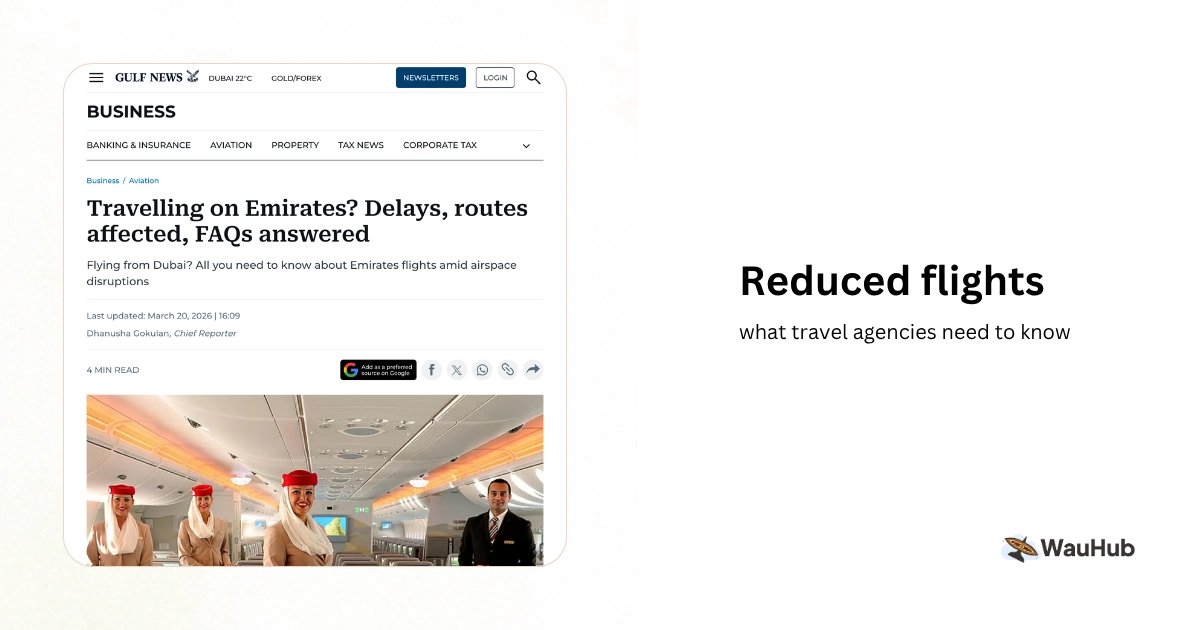
Gulf carriers have slashed 50 to 70 percent of their Middle East to Kuala Lumpur routes. Emirates, Qatar Airways, Etihad, all have cut frequencies dramatically. For agencies that built their business around Middle Eastern inbound groups and outbound Umrah or leisure packages via Gulf hubs, the impact is immediate and painful.
Cancellations are pouring in. Customers want refunds. Partial refunds. Credit notes. Some want to rebook to different destinations. Others just want their money back. Your WhatsApp is full of angry messages and your accounts team is drowning in paperwork.
But here is the thing: Malaysia is still targeting 35.6 million visitors for Visit Malaysia Year 2026. The tourists are still coming. They are just coming from different places now.
The Shift: Where the Tourists Are Coming From
With Middle Eastern routes disrupted, the source market mix for Malaysia has shifted significantly. The growth is now concentrated in three areas:
1. China
Chinese tourist arrivals to Malaysia have surged in 2026. The 30-day visa-free arrangement, direct flights from multiple Chinese cities, and aggressive marketing by Tourism Malaysia in China have made Malaysia a top destination. Tour groups of 30 to 50 pax are common. Family groups and FIT (Free Independent Travellers) are growing fast.
2. South Korea
Korean tourists have discovered Malaysia beyond KL. Langkawi, Penang, and Sabah are trending on Korean travel platforms. Korean tour operators are sending regular group departures, and the K-wave cultural connection makes Malaysia an attractive, affordable destination.
3. Russia and Central Asia
With European destinations less accessible for Russian travellers, Southeast Asia has become a primary alternative. Malaysia’s Muslim-friendly infrastructure, tropical climate, and competitive pricing attract Russian and Central Asian visitors. These groups tend to book longer stays of 7 to 14 days.
For ground handlers and DMCs, this means retooling. Your Mandarin-speaking guide roster matters more than your Arabic-speaking one right now. Your supplier relationships with halal-certified restaurants still matter, but you also need vegetarian and Korean BBQ options. Your itineraries need updating.

The Cancellation and Refund Problem
Before you can pivot forward, you need to deal with the mess behind you. Cancelled Middle Eastern trips mean a wave of financial admin that can paralyse your agency if handled manually.
What Agencies Are Dealing With
A typical cancelled group booking involves:
- Customer refund calculation: Full refund, partial refund, or credit note depending on your terms and how far in advance the cancellation happened
- Supplier cancellation fees: Hotels, airlines, transport providers, and activity operators each have different cancellation policies. Some charge 50 percent. Some charge nothing if cancelled 30 days out. Some refuse to refund at all
- The gap between what you refund and what you recover: You might owe the customer RM8,000 but only recover RM5,500 from suppliers. That RM2,500 gap is your agency’s loss unless your terms cover it
- E-Invoice credit notes: Every refund requires a credit note submitted to LHDN. If you issued the original e-Invoice, the credit note must reference it correctly
Why This Breaks Agencies Running on Spreadsheets
If your bookings, invoices, and supplier costs live in separate Excel files, processing 20 cancellations becomes a week-long nightmare. You need to:
- Find the original booking details
- Check which suppliers were booked and their cancellation terms
- Calculate the refund amount per customer
- Issue credit notes and submit to LHDN
- Track which suppliers have refunded you and which have not
- Reconcile the whole thing
In a proper system, the booking links to the invoices, the invoices link to the supplier vouchers, and the credit note references the original invoice automatically. What takes a week in Excel takes an afternoon in a system.
Partial Refunds and Credit Notes
Many agencies are offering customers a choice: partial refund now, or full credit towards a future booking. This is smart business, but it creates tracking complexity.
You need to know: which customers took credit, how much credit they have, when it expires, and whether they have used it. If this lives in a notebook or a WhatsApp message, it will get lost. Guaranteed.
Pivoting to VMY2026 Opportunities
The cancellations hurt. But VMY2026 is still happening, and the opportunity is real. Here is where to focus:
Inbound Groups from China, Korea, and Russia
If you have ground handling capability, now is the time to build relationships with tour operators in these markets. The demand is there. Chinese TOs are actively looking for reliable Malaysian ground handlers who can manage large groups efficiently.
What these TOs need from you:
- Fast quotation turnaround: A TO in Beijing sends you a 40-pax itinerary request. They expect a costed quotation within 24 hours. If you take 3 days, they have already booked with your competitor
- Passenger data management: 40 passengers means 40 sets of passport details, dietary requirements, room preferences. You need a system that tracks completion and flags missing data
- Multi-currency invoicing: Chinese TOs pay in USD or CNY. Korean TOs pay in USD or KRW. Your invoice goes out in their currency, but LHDN needs it in MYR. Both must be accurate
- Supplier coordination: Hotels, restaurants, transport, activities - each needs confirmed details. When the TO changes pax count from 40 to 43 two days before arrival, every supplier voucher needs updating
Domestic Tourism: Malaysians Exploring Malaysia
Here is the opportunity many agencies overlook. With international travel disrupted and VMY2026 promoting local destinations, Malaysians are travelling domestically more than ever.
Sabah and Sarawak are seeing record domestic visitor numbers. Perak, Terengganu, and Pahang are trending. Island destinations like Perhentian, Redang, and Tioman are fully booked months in advance for peak season.
Domestic tourism is different from inbound:
- Smaller group sizes: Families of 4 to 8, corporate groups of 15 to 30, school trips of 40 to 60
- MYR only: No currency conversion headaches, but you still need e-Invoices for every transaction
- Higher frequency, lower value: Instead of one RM80,000 group booking, you are handling twenty RM4,000 family bookings. The total revenue might be similar, but the admin workload is 20 times higher
- WhatsApp-first customers: Malaysian customers enquire, negotiate, confirm, and pay through WhatsApp. Your lead management must handle this volume
The agencies that win in domestic tourism are the ones that can process high volumes efficiently. Twenty family bookings means twenty quotations, twenty invoices, twenty payment collections, and twenty e-Invoice submissions. If each one takes 30 minutes of manual work, that is 10 hours just on admin. A proper system cuts that to minutes per booking.
Cuti-Cuti Malaysia Packages
Smart agencies are creating ready-made domestic packages:
- 3D2N Langkawi family packages with ferry transfers, hotel, island hopping, and meals included
- 4D3N Sabah adventure packages with Mount Kinabalu, river rafting, and Kundasang stays
- 2D1N Cameron Highlands weekenders targeting KL families looking for a quick getaway
- Corporate retreat packages in Janda Baik, Port Dickson, or Desaru Coast
Pre-built packages with fixed pricing are faster to sell. Customer enquires on WhatsApp, you send the package details and price, they confirm, you send a payment link. Done. No back-and-forth quotation process.
Managing the Financial Impact
The combination of cancellation losses and new business requires careful financial tracking.
Track Cancellation Losses Separately
Do not mix cancellation losses with normal operating expenses. Create a clear record:
- Total refunds issued to customers
- Total recovered from suppliers
- Net cancellation loss (the difference)
- Credit notes outstanding (customers who took credit instead of refund)
This gives you a clear picture of the actual financial impact. When you review your quarterly P&L, the cancellation losses are visible and explainable, not buried in a confusing spreadsheet.
Per-Tour Profitability for New Bookings
For every new inbound group or domestic package you sell, track the actual profit:
- Revenue: What the customer or TO paid you
- Supplier costs: Hotels, transport, meals, activities, guide fees
- Tour profit: Revenue minus costs
A Chinese inbound group generating RM85,000 in revenue with RM63,000 in supplier costs gives you RM22,000 profit (25.9 percent margin). A domestic family package generating RM4,000 with RM2,800 in costs gives you RM1,200 profit (30 percent margin).
Both are good business. But you need to see these numbers per tour, not as a lump sum at month-end.
E-Invoice Compliance Through the Chaos
Whether you are issuing refund credit notes for cancelled Middle Eastern trips or new invoices for Chinese inbound groups or domestic packages, every transaction must go through LHDN e-Invoice.
This means:
- Original invoices submitted to LHDN
- Credit notes for cancellations submitted to LHDN (referencing the original invoice)
- New invoices for replacement bookings submitted to LHDN
- Multi-currency invoices converted to MYR at Bank Negara rates
At high volume, manual submission through the MyInvois portal is not feasible. You need automated submission.
Your Pivot Checklist for Q2 2026
Deal with the Cancellations
- ☐ All cancelled bookings identified and documented
- ☐ Supplier cancellation fees confirmed and recorded
- ☐ Customer refunds or credits issued and tracked
- ☐ Credit notes submitted to LHDN for all refunds
- ☐ Net cancellation loss calculated and reported
Capture Inbound Asian Tourism
- ☐ Relationships established with Chinese, Korean, and Russian TOs
- ☐ Multi-currency invoicing set up and tested (USD, CNY, KRW)
- ☐ Passenger data management system ready for large groups
- ☐ Supplier voucher system linked to tour bookings
- ☐ Guide roster updated for Mandarin and Korean language capability
Build Domestic Tourism Revenue
- ☐ Domestic packages created with fixed pricing
- ☐ WhatsApp lead pipeline set up for high-volume enquiries
- ☐ Payment links ready for FPX, DuitNow QR, and card payments
- ☐ E-Invoice automation working for high-frequency, lower-value bookings
- ☐ Team capacity planned for domestic booking volume
How WauHub Helps You Pivot
WauHub is built for exactly this kind of operational shift:
Cancellation and refund management: Link credit notes to original invoices. Track supplier refunds against customer refunds. See your net cancellation loss clearly. Submit credit notes to LHDN automatically.
Multi-currency invoicing for inbound groups: Invoice Chinese TOs in USD or CNY, Korean TOs in KRW. Auto-convert to MYR at Bank Negara rates for LHDN e-Invoice submission.
High-volume domestic bookings: Process 20 family bookings as efficiently as one group booking. Quotation, invoice, payment collection, and e-Invoice submission — streamlined for volume.
Per-tour P&L: Whether it is an RM85,000 inbound group or an RM4,000 domestic package, see the actual profit per booking. No more guessing margins at month-end.
WhatsApp lead management: Capture leads from WhatsApp, assign to consultants, track through your pipeline. Nothing gets lost when volume spikes.
The Agencies That Adapt Will Win
The Middle East disruption is painful. Cancellations cost money and morale. But the agencies that process their cancellations cleanly, pivot to Asian inbound markets, and build domestic tourism revenue will come out of 2026 stronger.
VMY2026 is still bringing millions of tourists to Malaysia. They are just arriving from Beijing, Seoul, and Moscow instead of Dubai, Riyadh, and Doha. And millions of Malaysians are rediscovering their own country.
The question is not whether there is business. The question is whether your agency is set up to capture it.
Ready to pivot your operations? See how WauHub handles it.
We will walk you through managing cancellations, processing refunds, handling inbound groups from new markets, and scaling domestic tourism bookings — all in one system.